
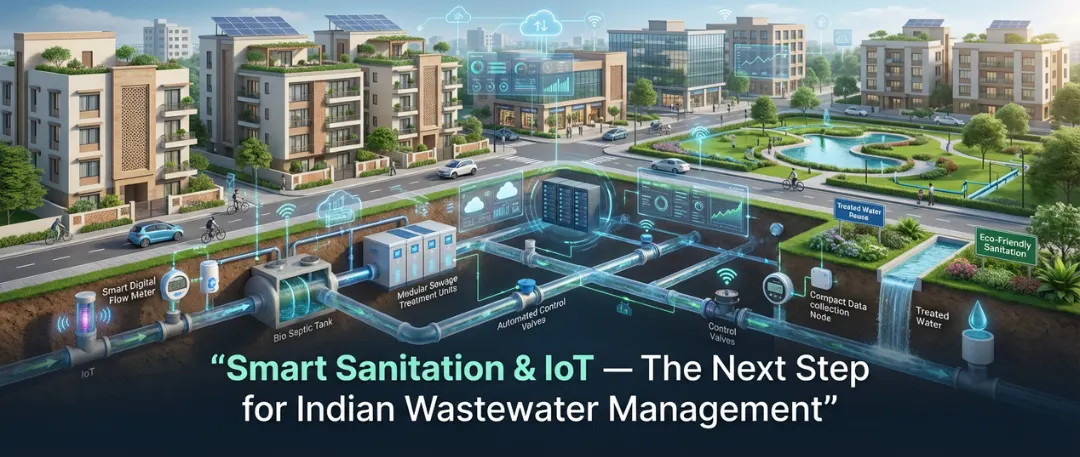
Smart Sanitation & IoT — The Next Step for Indian Wastewater Management
Introduction:
India’s sanitation story has evolved from open drains and manual cleaning to advanced wastewater treatment systems. Yet, even today, many urban and rural regions face serious challenges — overflowing septic tanks, groundwater pollution, and irregular maintenance.
The future of solving these problems lies in the intersection of smart technology and sustainable engineering. With the Internet of Things (IoT), sanitation systems are transforming into real-time, self-monitoring, data-driven networks — reducing human error, improving efficiency, and saving costs.
In this blog, we’ll explore how IoT-based smart sanitation is changing the face of wastewater management in India and how innovative systems like Crystal Bio’s bio-septic technology can integrate with this future.
1. Understanding Smart Sanitation
“Smart sanitation” refers to the use of digital tools, sensors, and connectivity to monitor and manage the sanitation process — from collection to treatment and reuse.
Traditionally, septic tanks and sewage systems operate blindly: users don’t know when tanks fill up, whether treatment is working efficiently, or if leaks occur. IoT eliminates that uncertainty.
A smart sanitation system uses:
- Sensors to detect liquid levels, flow rate, and system performance
- Data analytics to predict maintenance needs
- Cloud-based dashboards to monitor usage across multiple sites
- Automated alerts to service teams before failures happen
For India, where population density and infrastructure load are high, such smart systems can mean cleaner cities, lower costs, and greater sustainability.
2. Why India Needs Smart Wastewater Solutions
India generates over 60 billion liters of wastewater daily, and nearly 70% remains untreated.
Urban centers like Chennai, Trichy, and Coimbatore struggle with inadequate infrastructure, while rural areas depend heavily on septic tanks that often fail unnoticed.
Key challenges include:
- Lack of real-time monitoring → leads to overflow and contamination
- Manual maintenance dependence → delays, inefficiency, and safety risks
- Data gap → no centralized visibility on system performance
- High operational costs for treatment plants and municipal systems
Smart sanitation can solve these by providing actionable data and automating responses — making wastewater management more proactive than reactive.
3. How IoT Transforms Wastewater Management
IoT (Internet of Things) connects physical devices to the internet, enabling continuous data exchange.
In wastewater management, IoT plays a transformative role in four ways:
a. Real-time Monitoring
Sensors track parameters such as water level, flow, pH, and temperature, helping detect early faults or inefficiencies.
b. Predictive Maintenance
Instead of waiting for overflow or odor complaints, systems predict when cleaning or servicing is needed — saving money and avoiding health risks.
c. Energy Efficiency
Automated control of pumps and aerators ensures they run only when required, cutting energy costs and emissions.
d. Data-Driven Planning
Aggregated data helps municipal bodies or communities plan better infrastructure investments based on real usage patterns.
For homeowners, hostels, and industries, IoT integration means zero guesswork and maximum reliability in sanitation.
4. Integrating IoT with Bio-Septic Systems
Bio-septic tanks like Crystal Bio’s ABRT technology already revolutionize wastewater treatment by naturally breaking down waste without the need for frequent desludging or chemicals.
Integrating IoT takes that efficiency even further.
IoT-enabled bio-septic systems can:
- Measure tank levels and treatment efficiency
- Send SMS or app notifications before maintenance is due
- Monitor inflow and outflow rates to prevent overloading
- Provide environmental data for compliance reports
- Enable remote diagnostics for service engineers
Imagine a hostel or apartment complex in Trichy that receives a mobile alert when its tank nears capacity — allowing maintenance before any issue arises. That’s smart sanitation in action.
5. Benefits for Urban and Rural India
IoT-driven sanitation isn’t just a convenience — it’s a necessity for sustainable growth.
Urban Benefits:
- Reduced sewage overflows and odor complaints
- Real-time management for apartment complexes and industries
- Compliance with local pollution control norms
- Better resource allocation for maintenance teams
Rural Benefits
- Early warnings prevent tank failures in remote areas
- Lower maintenance costs through predictive scheduling
- Data helps rural bodies plan eco-friendly sanitation programs
- Greater awareness and accountability among communities
6. Case Study Example: Smart Sewage for Hostels & Institutions
- Institutions like schools and hostels in Tamil Nadu face unique challenges — large usage, variable load, and limited supervision.
- An IoT-enabled bio-septic tank allows administrators to track performance remotely, schedule cleaning efficiently, and ensure hygiene standards without manual inspection.
- This combination of sustainability, automation, and safety sets a new benchmark for institutional sanitation.
7. The Future — Toward Smart Cities and Circular Water Systems
As India pushes toward the Smart Cities Mission and sustainable housing, IoT-based sanitation will become standard.
The future will include:
- Centralized dashboards integrating all city septic systems
- AI-powered wastewater recycling decisions
- Automatic leak detection and water-quality analysis
- Integration with renewable energy systems
Crystal Bio’s modular design makes it ideal for future IoT upgrades — bridging the gap between eco-engineering and digital intelligence.
8. Challenges and the Road Ahead
While promising, smart sanitation adoption faces hurdles:
- Upfront installation costs
- Need for digital infrastructure and internet connectivity
- Training and awareness for maintenance staff
- Data privacy and management concerns
However, with India’s growing focus on sustainable infrastructure, these challenges are being rapidly addressed. As technology costs drop and awareness rises, smart sanitation will move from pilot projects to everyday practice.
9. Why Crystal Bio Is Poised for This Future
Crystal Bio’s systems are built on innovation — from advanced bacterial digestion to sustainable materials and modular designs.
By integrating IoT-ready features, Crystal Bio is prepared to offer:
- Smart sensors compatible with its ABRT systems
- Data dashboards for institutional clients
- Automated alerts for maintenance
- Eco-reporting tools aligned with Tamil Nadu pollution norms
This makes Crystal Bio not just a manufacturer but a technology partner for a cleaner, smarter India.
Conclusion
Smart sanitation represents a fusion of engineering, sustainability, and digital innovation.
By combining bio-septic technology with IoT, India can transform wastewater from a problem into a data-driven opportunity — ensuring cleaner environments, healthier communities, and efficient urban systems.Crystal Bio is proud to lead this transition — one installation at a time — making every drop count in building a smarter, greener future.
1 What is IoT in sanitation?
IoT (Internet of Things) refers to using sensors and connectivity to monitor and manage sanitation systems automatically, improving performance and reliability.
2 Can IoT be added to existing bio-septic tanks?
Yes, Crystal Bio’s modular systems can be upgraded with sensors and alert devices to make them IoT-ready.
3 Is IoT sanitation expensive?
Initial setup costs are slightly higher, but predictive maintenance and energy savings make it cost-effective in the long term.
4 Who benefits most from smart sanitation?
Apartments, hostels, institutions, and industries — anywhere regular monitoring or large-scale wastewater management is required.
5 Does Crystal Bio offer IoT-compatible systems?
Yes, Crystal Bio is developing and deploying IoT-ready features for residential and commercial installations across Tamil Nadu.