
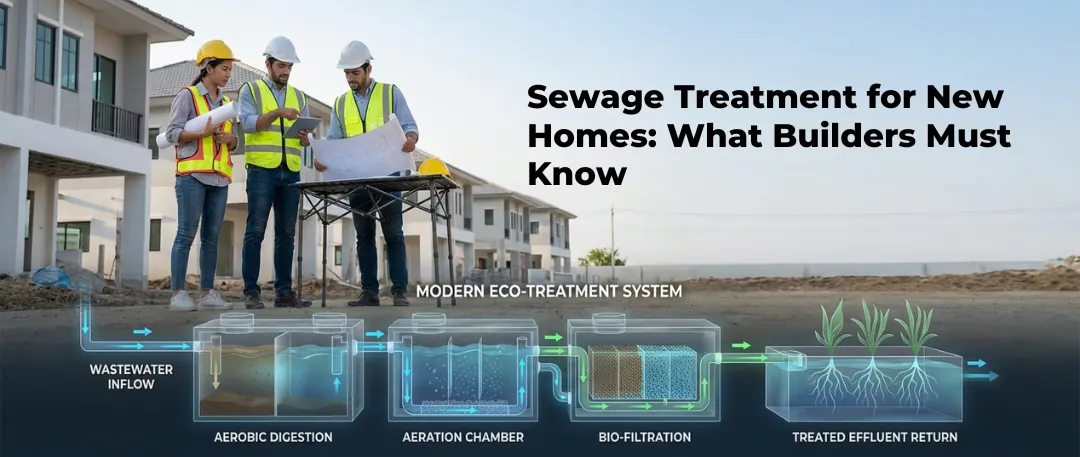
Sewage Treatment for New Homes: What Builders Must Know
As modern housing projects evolve, homebuyers are becoming more aware of sanitation standards and environmental responsibility. Whether you are building individual houses, gated communities, or apartment projects, proper sewage treatment is no longer optional. It is a mandatory requirement for safety, compliance, and long-term property value.
In many cities and towns, municipal sewage systems are either overloaded or unavailable. This makes on-site sewage management essential. Builders who plan ahead not only avoid legal issues but also add tremendous value to their projects.
In this blog, we explore everything builders should know about sewage treatment for new residential developments.
Why Sewage Treatment Must Be Planned During Construction
For decades, sewage management has been treated as a final step in construction. Today, this approach is outdated and risky. Sewage planning must begin during the initial architectural phase.
Here’s why this matters:
- Avoids future excavation
- Ensures proper alignment of plumbing
- Avoids contamination of soil and groundwater
- Reduces long-term maintenance
- Supports government compliance
- Protects property resale value
- Builds brand trust among buyers
Builders who incorporate sewage systems early ensure better functionality and avoid expensive redesign.
Legal and Regulatory Requirements
Most states and urban development authorities now insist on proper sewage treatment, especially for new residential projects. Regulatory bodies may include:
- Local municipal authority
- Pollution control board
- Town planning department
- RERA guidelines
Many approvals require proof of sewage planning before construction clearance. Buildings without proper sewage treatment may risk delays, penalties, or rejection of completion certificates.
Why Traditional Septic Tanks Are No Longer Enough
Traditional septic tanks only store and partially treat waste. Over time, they cause serious problems:
- Groundwater pollution
- Bad odor
- Soil contamination
- Frequent desludging
- Mosquito breeding
- Overflow risks
Today’s households need a system that treats sewage, not just stores it.
Modern Solutions: Bio-Septic Tanks and Bio-Digesters
Bio-septic systems are the most preferred modern solution for homes. These systems use biological processes to break down waste and convert sewage into treated water.
Key advantages:
- Zero or minimal maintenance
- No foul smell
- No sludge accumulation
- No chemical usage
- Environment-friendly
- Long life system
- Safe for groundwater
- Suitable for all soil types
Builders prefer bio-systems because they are efficient, compact, and cost-effective across project lifecycles.
Ideal for All Types of Residential Projects
Bio-septic systems can be installed for:
- Independent houses
- Duplex villas
- Row houses
- Apartments
- Farmhouses
- Gated communities
- Staff quarters
- Resorts
Whether the project has 1 home or 200 units, the system can be scaled easily.
Treated Water Reuse: An Added Advantage
One of the biggest benefits is reuse of treated water. Water can be reused for:
- Gardenin
- Landscaping
- Irrigation
- Car wash
- Cleaning
- Toilet flushing
This reduces water costs and makes the project more sustainable.
Space Planning Made Simple
One misconception builders have is that sewage treatment occupies a lot of space. Modern systems need minimal space and can be planned in:
- Backyards
- Under open areas
- Common spaces
- Near boundary areas
- Underground
Because bio-septic tanks are compact, layout planning becomes easier.
Maintenance and Long-Term Cost Savings
Bio-septic systems drastically cut operational costs. Traditional septic tanks often require regular desludging. Bio systems eliminate or reduce this need, saving lakhs over a few years.
- Long-term benefits include:
- Lower maintenance cost
- No tank cleaning
- No sewage tankers required
- Less civil and plumbing expenses
Builders save money, and homeowners enjoy a trouble-free system.
Why Builders Should Choose Bio-Septic Systems
Benefits to builders:
- Easy installation
- Low cost
- No chemical treatment
- Space saving
- Scalable
- Faster approvals
- Reduced maintenance complaints
Benefits to homeowners:
- No smell
- Safe for the environment
- No sewage overflow
- Lower maintenance expenses
Final Thoughts
For new homes, sewage treatment is not just a requirement. It is part of responsible construction. Builders who choose modern bio-septic systems ensure clean disposal, long-lasting performance, and a healthier living environment for every homeowner.
By adopting eco-friendly treatment systems today, builders future-proof their projects, enhance their brand value, and significantly contribute to community well-being.
1 Do all new homes require sewage treatment?
2 Are bio-septic tanks better than normal septic tanks?
Yes. Bio systems treat waste completely, avoid smell, reduce maintenance, and protect groundwater.
3 Can treated water be reused?
4 Is sewage treatment expensive for builders?
No. In fact, modern systems are cost-effective and save money in long-term maintenance.
5 How much space is required?
Very minimal space. It depends on usage, but modern systems are compact.
6 Does it require frequent cleaning?
No. Bio-septic tanks need minimal or no desludging.